

Mobility law transposing
at last the European directive
EU 2019 /2121
Introduction
The Law of February 17th, 2025 (“Mobility Law”), which entered into force on March 2nd, 2025, represents a significant step forward in the modernization of commercial companies law in Luxembourg, by adapting:
- the amended law of August 10th, 1915 on commercial companies, and
- the amended law of December 19th, 2002 on the Trade and Companies Register as well as the bookkeeping and annual accounts of companies.
These amendments aim to transpose Directive (EU) 2019/2121 of November 27th, 2019, which amends Directive (EU) 2017/1132 with regard to cross-border conversions, mergers and divisions of companies (“Directive”). The purpose of this legislative reform is twofold: on the one hand, to ensure greater legal certainty for companies involved in such operations, and on the other hand, to harmonize the applicable rules at European level, in order to facilitate the mobility of companies within the internal market of the European Union.
1. Distinction between the general regime and the special regime
One of the key contributions of the Mobility Law is the structuring of conversion, merger, and division operations under two distinct legal regimes:
a) General regime
The general regime builds upon the existing provisions of the amended law of August 10th, 1915 on commercial companies, while incorporating certain changes introduced by the new legislation. It applies to domestic operations involving exclusively one or more Luxembourg companies, as well as to cross-border operations falling outside the scope of the special regime, namely, operations involving companies established outside the European Union.
As part of the simplification measures introduced by the Mobility Law, a major advancement concerns intra-group restructuring operations at the national level: the simplified merger between sister companies. Until now, this simplified regime applied only to so-called “vertical” mergers, where the absorbing company held at least 90%, but not all of the shares, units or other securities conferring voting rights at the general meetings of the absorbed company or companies.
From now on, it also applies to “horizontal” mergers, where the shares of the merging companies are held directly or indirectly by a single person, or are held in the same proportion by the same persons.
Therefore, two sister companies can merge without the issuance of new shares, provided that their shareholding structure is identical or unified. This measure aims to simplify intra-group restructurings by reducing administrative formalities.
b) Special Regime
Relevant operations. The Mobility Law introduces a major change by creating a special regime that applies exclusively to cross-border operations within the European Union, such as mergers, divisions, and conversions.
Eligible companies. The scope of the new procedures under the Mobility Law is limited to cross-border operations involving a Luxembourg-law governed private limited liability company (SARL), public limited company (SA), or partnership limited by shares (SCA), and at least one company from another member state of the European Union as referred to in Article 119(1) of Directive (EU) 2017/1132.
Certain legal forms are excluded from this regime, in particular simplified jointstock companies (SAS), cooperatives (even if organized as public limited companies in accordance with Article 820-1 of the amended law of August 10th, 1915 on commercial companies), undertakings for collective investment in transferable securities (UCITS), as well as companies in liquidation, subject to insolvency proceedings or specific restructuring measures.
In such cases, all aspects of the cross-border operations covered by the special regime that are not specifically addressed by its provisions will be governed by the general regime.
2. Two-tier legality control mechanism
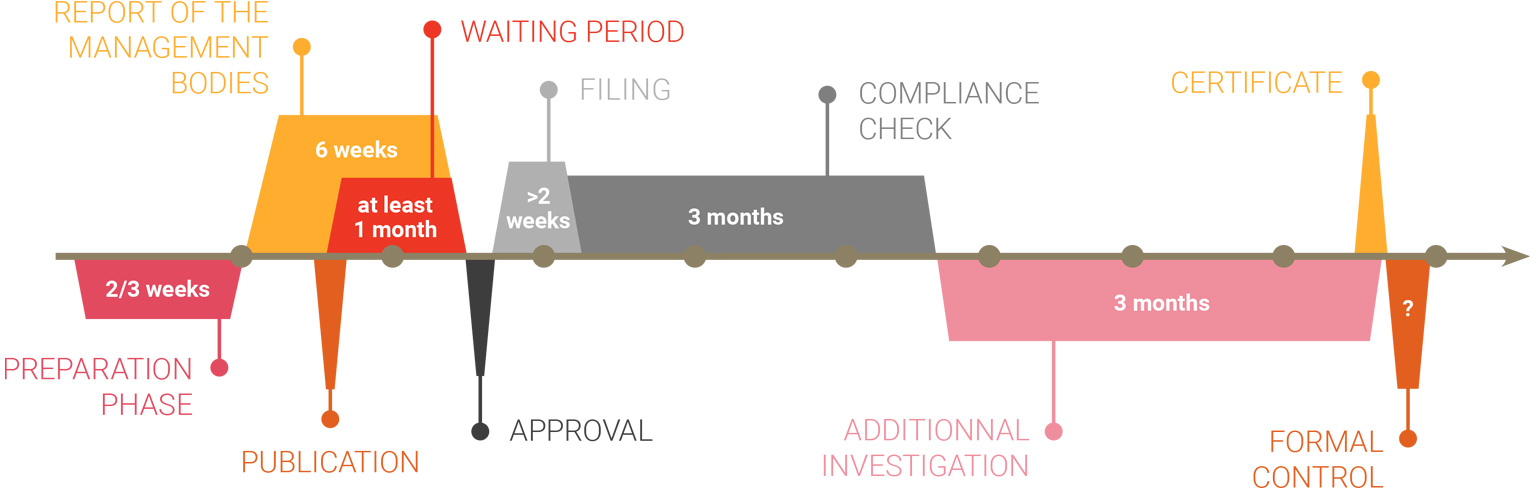
The Mobility Law introduces a two-tier legality control mechanism for European cross-border operations, which includes a preliminary control in the departure member state and a final control in the destination member state. Competent authorities in each member state are responsible for these controls to ensure the compliance of the operations.
In Luxembourg, the notary has been designated as the competent authority to carry out this legality check.
a) Compliance check and anti-abuse measures
The Luxembourg notary conducts an initial legality check to ensure that the crossborder operation complies with all legal requirements and formalities applicable in the Grand Duchy of Luxembourg.
The notary is the competent authority to issue the certificate in the following cases:
- when the company is emigrating from Luxembourg,
- when the company merging (by incorporation) or being absorbed (by absorption) is a Luxembourg company, and
- when the company being split is a Luxembourg company.
This check must be carried out within three months from the date of receipt of the documents and information relating to the approval of the European cross-border operation by the general meeting of the absorbed/split company. This period may be extended by an additional three months in the event of serious suspicion of abuse or fraud.
Furthermore, if deemed necessary, the notary may consult other competent authorities, including those in the relevant member state, in order to obtain the information and documents needed to carry out the legality check. For assessment purposes, the notary may also appoint an independent expert, at the company’s expense.
This control will result in either:
- the issuance of a pre-operation certificate, if the cross-border operation is found to comply with all applicable conditions. The certificate will then be filed by the notary with the Luxembourg Trade and Companies Register and transmitted to the destination member state via the Business Registers Interconnection System (BRIS), or ;
- the granting of an additional three-month period for the company to meet the necessary requirements, or ;
- the refusal to issue the pre-operation certificate, if the notary finds that the operation is being carried out for abusive or fraudulent purposes.
b) Validation of the operation
The final control is carried out by the competent authorities of the destination country and consists of verifying that all legal requirements have been fulfilled and that the operation complies with the local rules of the destination country.
The effective date of the European cross-border operation is determined by the destination member state. However, this date cannot precede the issuance of the pre-operation certificate.
Where Luxembourg is the destination country, the Luxembourg notary ensures, in particular, that:
- the rules related to the employees’ participation have been established in accordance with applicable labour law;
- the company relocating to Luxembourg complies with the incorporation and registration requirements under Luxembourg law;
- in the case of a merger, the common draft terms have been approved in identical terms by all the companies involved.
In Luxembourg, the effective date of the European cross-border operation is the date on which the notary confirms that all the applicable conditions have been fully satisfied.
3. Minority shareholders’ rights
The Mobility Law places particular emphasis on protecting the interests of shareholders, creditors, and employees. These stakeholders, often exposed to risks of fraud or abuse during European cross-border operations, now benefit from enhanced measures aimed to ensure greater transparency and legal certainty.
a) Minority shareholders’ rights
Enhanced right to information. Management bodies are now required to prepare a detailed report for shareholders, outlining the key aspects of the operation, including the share exchange ratio and any cash compensation, the valuation methods used to determine them, and the rights and remedies available to shareholders. The report must also explain the overall impact of the operation on the shareholders.
However, this report is not mandatory where shareholders have unanimously agreed to waive this requirement. In addition, companies with a sole shareholder are exempt from preparing the report.
The report must be made available to shareholders at least six weeks before the general meeting convened to approve the cross-border operation. Each shareholder has the right to express an opinion on the draft terms. After reviewing any comments submitted, the general meeting may decide to approve, amend, or reject the proposed operation.
Right of withdrawal and challenge of the share exchange ratio. Shareholders also benefit from two additional rights:
- shareholders who oppose a European cross-border operation now have the right to exit the company in exchange for cash compensation. This withdrawal right must be exercised for all shares held,
- shareholders who choose to remain in the company retain the legal right to challenge the proposed share exchange ratio and may request additional financial compensation.
An independent expert must carry out a valuation to ensure the fairness of the proposed share exchange ratio and cash compensation. However, shareholders may unanimously agree to waive this requirement. This requirement also does not apply to companies with a sole shareholder.
b) Creditors’ rights
Creditors whose claims arose prior to the publication of the draft project and are not yet due at that time may, after prior notice to the debtor company, petition the court for adequate safeguards if they can demonstrate that the cross-border operation puts the recovery of their claims at risk.
This legal action must be brought within three months following the publication of the draft terms, but it does not have a suspensive effect on the operation. The debtor company may dismiss the legal action by paying the creditor, even if the claim is not yet due.
c) Employees information
Management must also provide employees with a report detailing the planned restructuring. This report must explain how the operation will affect employment relations, what measures will be implemented to protect employees, and any significant changes to working conditions, workplace locations, or the company’s operations. Additionally, the report must address the potential impact on the company’s subsidiaries.
However, this report is not required if neither the company nor its subsidiaries have employees other than those sitting on a management or administrative body.

